
How to Bend Guitar Strings Perfectly for Beginners

String bending is one of the most expressive techniques in guitar playing. If you’ve ever listened to a blues solo or a classic rock lead line, chances are you’ve heard guitar bends adding emotion and character to the music. But many beginners struggle with this skill because bending guitar strings can either sound amazing—or completely out of tune.
In this guide, you’ll learn how to bend guitar strings correctly, how to practice bending to the right pitch, and a few simple tricks that make bends sound clean and professional.
 Return to All Guitar Lessons
Find this website helpful? Click the button to show your support.
What Is String Bending on Guitar?
String bending is a guitar technique where you push or pull a string across the fretboard to raise the pitch of a note.
Instead of playing the next note directly, you bend the string until it reaches the pitch of that higher note. This creates a smooth, vocal-like effect that adds emotion and expression to your playing.
You’ll hear bends frequently in styles like:
-
Blues
-
Rock
-
Classic rock solos
-
Lead guitar melodies
For example, a simple melody can feel flat when played as straight notes. Add a bend, and suddenly the phrase becomes expressive and musical.
Why Bending Guitar Strings Often Sounds Bad for Beginners
One of the biggest issues beginners face when learning how to bend guitar strings is not bending the string far enough—or bending it too far.
When a bend isn’t accurate, the note ends up:
-
Flat (not bent far enough)
-
Sharp (bent too far)
Unlike random pitch changes, guitar bends are meant to reach specific notes. If you miss that target pitch, the bend will sound off.
The good news is that this skill improves quickly once you understand what you're aiming for and how to practice it properly.
In the video below, I go over a super simple trick you can use to always bend your strings to the correct pitch.
Understanding the Different Types of Guitar Bends
Before practicing bends, it’s helpful to understand the common types you’ll see in guitar music.
Quarter-Step Bend
A quarter-step bend raises the pitch slightly above the original note.
This bend is common in blues and adds subtle expression. It doesn’t reach the next full note but instead creates a bluesy feel.
Half-Step Bend
A half-step bend raises the pitch by one fret.
For example:
-
Bend a B note
-
Until it reaches C
In guitar notation, this is usually marked with a curved arrow and the word “half.”
Whole-Step Bend
A whole-step bend or full-step bend raises the pitch by two frets.
For example:
-
Bend C
-
Until it reaches D
This is one of the most common bends in rock and blues guitar solos.
Larger Bends
Occasionally, you’ll see bends larger than a whole step, such as two-step bends. These require more strength and control but follow the same concept—bending until the pitch reaches the target note.
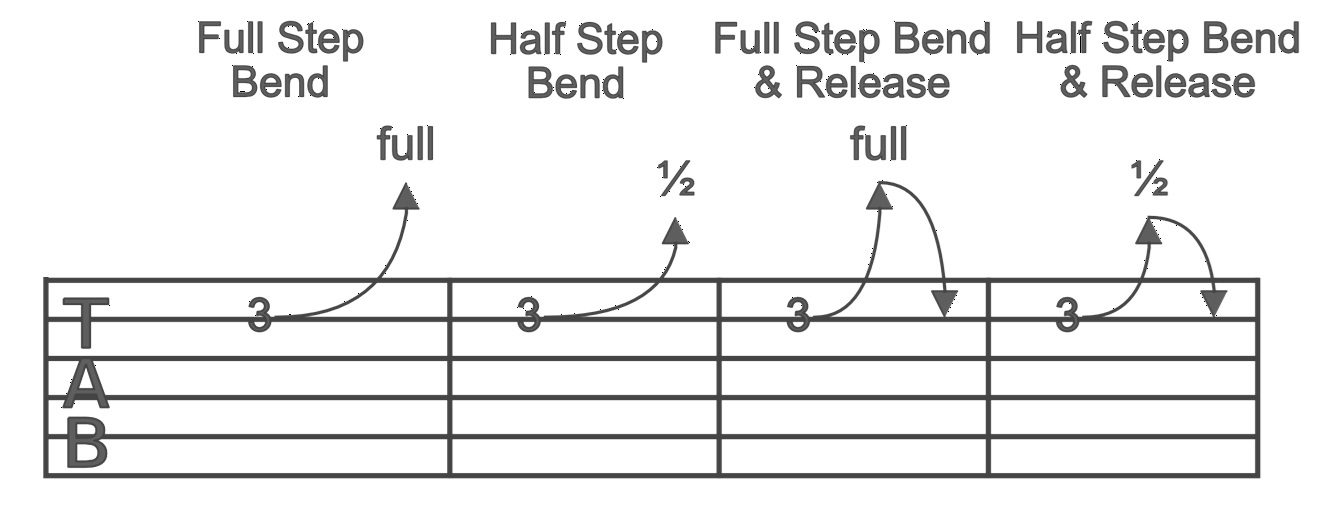
Below is a diagram that shows how bends are represented in guitar tablature. It is a curved arrow that tells you how far to bend the string - full step, half-step, etc.
Sometimes you will hold a bend or sometimes you will hold and release a bend.
Choosing the Right Strings for Easier Bends
The thickness of your guitar strings plays a huge role in how difficult bends feel.
Heavier gauge strings (like .010 sets) produce a fuller tone but require more finger strength to bend.
Lighter strings (like .009 sets) are easier to bend and are often preferred by players who struggle with finger strength.
Some guitarists use hybrid string sets, which combine heavier bass strings with lighter treble strings.
For example:
-
Bottom strings: heavier for rhythm tone
-
Top strings: lighter for easier bending
Since most bends happen on the high E, B, and G strings, lighter gauges can make bending much easier for beginners.
LAUREN RECOMMENDS: I highly recommend the D'Addario EXL125-3D Nickel Wound Strings here.
Proper Technique: How to Bend Guitar Strings Correctly
Learning the correct technique makes a huge difference when practicing bends.
Use Multiple Fingers
Instead of bending with one finger, use three fingers together.
For example:
-
Place your third finger on the target fret
-
Support it with your second and first fingers behind it
This gives you more strength and control.
Use Your Thumb for Leverage
A helpful trick is to bring your thumb over the top of the neck.
Your thumb acts as a pivot point that allows your hand to push the string upward more easily.
Many legendary players use this technique because it provides better leverage for bends.
Push Into the Fretboard First
A common mistake is pushing the string sideways without pressing into the fretboard.
Instead:
-
Press the string firmly into the fretboard
-
Then push the string upward
This ensures the note rings clearly while bending.
Your fingers should stay relatively stable while your wrist rotates slightly to help push the string upward.
This motion provides much more strength and control.
A Simple Trick to Practice Bending in Tune
One of the best ways to learn how to bend guitar strings accurately is by using a tuner.
Step 1: Play the Starting Note
Play the note you want to bend.
For example:
-
Play C on the 8th fret of the high E string
Step 2: Identify the Target Note
If you’re doing a whole-step bend, your target note would be D.
Play the D first so you know what it should sound like.
Step 3: Bend Toward the Target Pitch
Now bend the C up while watching your tuner.
The tuner will show you:
-
If you're flat (not bending enough)
-
If you're sharp (bending too far)
This removes the guesswork and trains both your ear and muscle memory.
Where Beginners Should Start Practicing Bends
When first learning how to bend guitar strings, start on the high E string.
Why?
-
It’s the thinnest string
-
It’s the easiest to bend
After that, move to:
-
B string
-
G string
These strings get progressively thicker and require more strength.
Why String Bending Gets Easier Over Time
When you practice bending regularly, two things improve:
Ear Training- your ear begins to recognize when a bend reaches the correct pitch. Eventually, you’ll know instinctively when the note is in tune.
Muscle Memory - Your fingers learn exactly how far to push the string for each type of bend.
This is why experienced guitarists can bend perfectly without even thinking about it.
Final Thoughts on Learning How to Bend Guitar Strings
Learning how to bend guitar strings is a fundamental step in becoming a more expressive guitarist. While it may feel difficult at first, consistent practice quickly improves both your accuracy and strength.
Remember these key points:
-
Always bend toward a specific target note
-
Use multiple fingers for support
-
Use your thumb as leverage
-
Start on the high E string
-
Practice bends using a tuner for accuracy
With patience and practice, string bending will become second nature—and your guitar playing will sound far more expressive and musical.
And if you haven't checked out my video lesson on this topic, make sure to check it out below.